


Experience Hornbill Festival 2026
The first time I stood at the edge of the Kisama arena, it was 7:40 in the morning and the fog had not yet decided to leave.
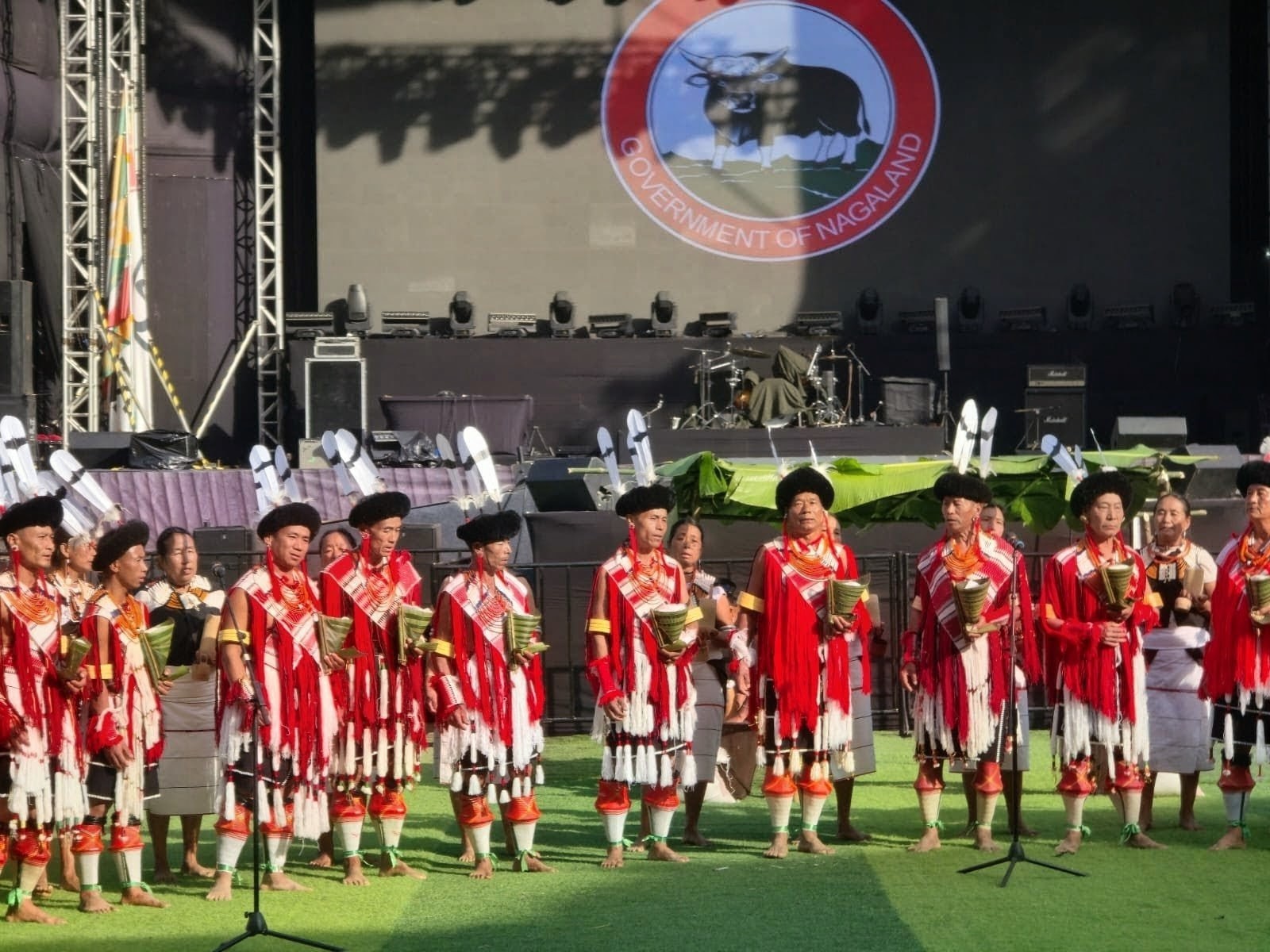
Somewhere below me, in the amphitheatre carved into the hillside, a Konyak elder was adjusting the hornbill feathers on his headgear with the unhurried patience of a man who has done this every December for forty years. His face carried the faded blue-black lines of a tattoo earned in a different century. Behind him, a log drum the length of a canoe waited to be struck. And when it was struck — one deep, hollow, ancestral boom that rolled across the valley and came back to us off the far ridge — every single person in that amphitheatre stopped breathing at the same time.
That is the moment I tell people about when they ask me what the Hornbill festival actually is.
Because you can read that it is called the "Festival of Festivals." You can read that seventeen major Naga tribes gather at one heritage village for ten days each December. You can read the statistics, the visitor numbers, the list of events. None of it prepares you for the sound of that drum.
Hornbill 2026 is coming. And if you have been circling this trip in your head for years — telling yourself next year, next year — this is the year to stop circling and start booking.
At BreakBag Holidays, we have been running Hornbill Tour packages into Nagaland since 2015. We have hosted travellers from India, the USA, Russia, Thailand and the UAE at Kisama. We have watched first-timers cry at the closing ceremony. We know which homestay in Nagaland puts you closest to the action, which villages are worth the drive, and which mistakes cost people their entire festival.
So this is not a listicle written from a desk in Delhi. This is the guide I wish someone had handed me the first time.
Why the Hornbill Festival Is Called the Festival of Festivals
Every tribe in Nagaland has its own festival.
The Angami have Sekrenyi. The Ao have Moatsu. The Konyak have Aoleang. The Sumi have Tuluni. The Chakhesang, the Lotha, the Zeliang, the Phom, the Chang, the Khiamniungan, the Yimchunger, the Pochury, the Rengma, the Sangtam, the Kuki, the Kachari, the Garo — each with its own calendar, its own harvest rites, its own songs that belong to nobody else.
For most of history, these festivals lived and died inside their own villages. A traveller could spend a lifetime in Nagaland and never see them all.
Then in 2000, the Government of Nagaland did something quietly radical. It created a festival of the festivals — a single ten-day window where every tribe would come down from its own hills and set up its own morung (a traditional bachelors' dormitory and cultural hall) in one shared heritage village. Not a performance staged for outsiders. A gathering that the tribes themselves wanted.
That is why the Hornbill festival earns its title. It is not one culture on display. It is seventeen, side by side, cooking their own food, singing their own songs, arguing good-naturedly about whose rice beer is superior — and letting you walk right through the middle of it.
The festival takes its name from the Great Indian Hornbill, a bird whose feathers appear in the ceremonial headgear of almost every Naga tribe. The bird is a symbol of valour, of beauty, of the sacred. Fittingly, the festival that carries its name has become the single most important cultural event in Northeast India.
Things to do #1–4:
1. Walk the morung circuit slowly. Seventeen tribal houses, each a full-scale traditional structure. Do not rush this. Sit inside one. Let someone offer you tea.
2. Watch the log drum ceremony. A hollowed tree trunk, sometimes thirty feet long, struck in rhythm by a dozen men. It was once used to summon warriors. It will rearrange your ribcage.
3. Try the rice beer — properly. Zutho (Angami) and thutse are served in bamboo mugs. Each tribe brews differently. Ask before you photograph.
4. Meet a Konyak elder. The facial tattoos of the last headhunting generation are disappearing with them. This is living history, and it is finite.
If Northeast India's tribal festivals pull at something in you, our Ziro Festival tour packages in neighbouring Arunachal Pradesh follow the same philosophy — music, mountains, and community, with nothing manufactured.
Hornbill Festival 2026 Dates, Venue & What's New This Year
Let us get the practical questions answered first, because this is where most people get tripped up.
When is Hornbill Festival 2026?
The Hornbill festival 2026 is expected to run from 1st to 10th December 2026, following the festival's fixed annual window. The Government of Nagaland has held these dates every year since the festival's inception. Official confirmation for 2026 typically comes from the state tourism department a few months ahead — we always recommend verifying on the Nagaland Tourism official website before locking flights.
Where is it held?
At Kisama Heritage Village, roughly 12 kilometres south of Kohima on the Kohima–Imphal highway. The name "Kisama" comes from the two villages that donated the land: Kigwema and Phasama.
Remember that name. Kigwema. It matters enormously, and I will come back to it.
The two ceremonies — and why you must choose
Here is what almost no blog tells you: the opening and the closing of Hornbill are two genuinely different experiences.
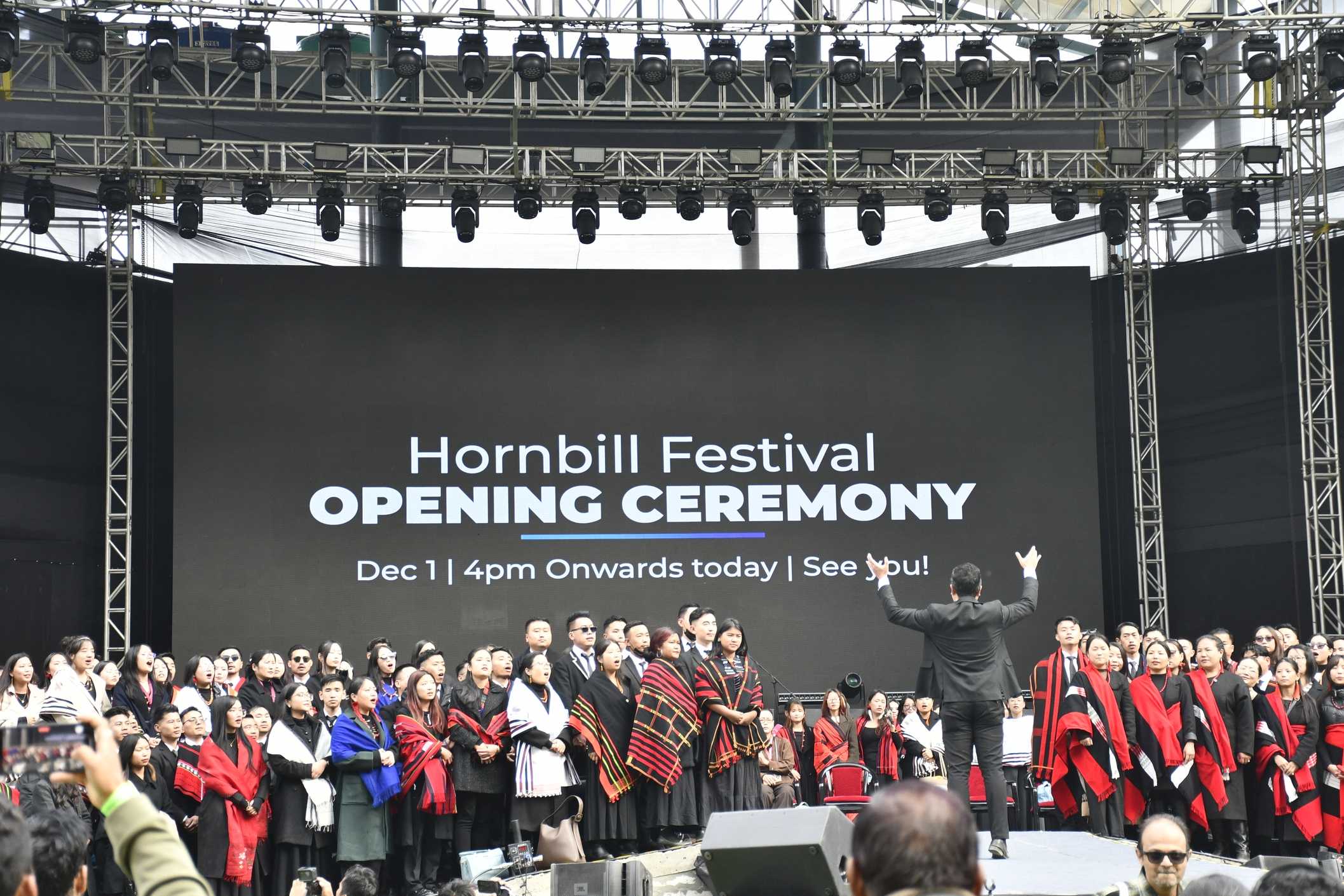
The opening ceremony (1st December) is formal, ceremonial, electric with anticipation. The dignitaries, the grand tribal procession, the first log drum. The energy is one of arrival. This is the Hornbill of the postcards.
The closing ceremony (10th December) is looser, warmer, more emotional. By then the tribes have spent nine days living beside each other. The performances are less rehearsed and more joyful. There is a bittersweetness to it that the opening simply does not have. There is also the Hornbill International Rock Contest reaching its finals, and the night carnival at its peak.
Neither is better. They are different. BreakBag runs a dedicated package for Hornbill for each — and you should pick deliberately, not by accident.
Things to do #5–9:
5. Attend the grand opening procession if you are on the opening-ceremony trip — seventeen tribes entering the arena in full ceremonial dress.
6. Catch the Hornbill International Rock Contest. Nagaland is India's rock and blues capital and it is not close. The finals are astonishing.
7. Watch the Naga wrestling. Two men, a belt grip, no strikes. Ancient, technical, and far more gripping than it sounds.
8. Try the Naga chilli eating contest — or, more sensibly, watch it. The Raja Mircha (Bhut Jolokia) is one of the hottest chillies on earth.
9. Stay for the night carnival in Kohima. Food stalls, live music, and a town that does not sleep for ten days.
One critical warning: the Inner Line Permit.
Every Indian traveller from outside Nagaland needs an Inner Line Permit (ILP) to enter the state. Foreign nationals must register with the Foreigners Registration Officer. This is not included in most Hornbill festival Packages — including ours, and we say so plainly in our exclusions. Apply online well in advance. Every December, people are turned back at Dimapur for not having one. Do not be that traveller.
Inside Kisama Village — The Beating Heart of the Celebration
Kisama Village is not a village in the ordinary sense. It is a purpose-built Naga Heritage Village, and it is the stage on which the entire festival happens.
Picture a natural amphitheatre cut into a green hillside. At the base, an open arena of packed earth. Rising around it in a horseshoe, seventeen traditional morungs — each one built by its own tribe, in its own architectural style, with its own carved house-posts, its own skull motifs, its own thatch.
Each morung is a small embassy. Inside, the tribe's own people cook their own food on open fires, sell their own weaves and jewellery, brew their own rice beer, and — if you approach with respect rather than a camera lens first — will talk to you for hours.
This is what separates Hornbill from every other festival I have attended in India. Nothing at Kisama Village is performed at you. It is happening, and you are permitted to be present.
A few things I have learned about doing Kisama properly:
• Arrive early. The gates open around 8 AM. The first hour, before the crowds, is when the elders are most willing to talk.
• Bring cash. Card machines are unreliable. The handloom sellers, the food stalls, the artisans — cash.
• Ask before photographing. Always. The tattooed Konyak elders in particular are photographed relentlessly, often rudely. A moment of eye contact and a gesture towards your camera costs you nothing and changes everything.
• Eat at the morungs, not the food court. Smoked pork with bamboo shoot. Axone (fermented soybean). Sticky rice steamed in leaf. This is the real thing.
• Budget a full day just for wandering. The World War II Museum and the Bamboo Pavilion are on-site and worth your time.
Things to do #10–15:
10. Eat smoked pork with axone at a morung fire. Non-negotiable.
11. Buy a handwoven Naga shawl directly from the weaver. Each tribe's pattern is distinct and coded with meaning.
12. Visit the WWII Museum at Kisama. Nagaland's war history is extraordinary and under-told.
13. Watch traditional indigenous games — bamboo stilt walking, top spinning, the pole-climbing contest.
14. Listen to the folk songs. Naga polyphonic singing is unlike anything else in India.
15. Attend the Naga Kitchen demonstrations and learn how bamboo shoot and fermented soybean actually work.
Choosing the Right Homestay in Nagaland for Your Festival Trip
Now we come to the single most important decision of your entire trip. And I want to be blunt about it, because it is where most travellers go wrong.
Where you sleep during Hornbill determines what your Hornbill actually is.
Most tourists book a hotel in Kohima town. It seems logical. Kohima is the capital, it has the most rooms, it has restaurants. But here is what actually happens: every December, the 12-kilometre road from Kohima to Kisama becomes a slow-moving river of traffic. What should be a 25-minute drive routinely takes 90 minutes to two hours each way. You lose your mornings. You lose your evenings. You lose the festival.
Meanwhile, some of us are staying in Kigwema.
Kigwema: the nearest homestay from Hornbill Festival
Kigwema is the Angami village that donated half the land Kisama sits on. It is roughly 2 kilometres from the festival gate. You can walk it. On the morning of the opening ceremony, while the Kohima crowd is stuck in a jam somewhere near Zubza, you are strolling downhill with a cup of tea in your hand.
This is why every single BreakBag Hornbill package — both opening and closing — is built on 4 nights in a Kigwema homestay. It is not a cost decision. It is a proximity decision. The nearest homestay from Hornbill Festival is, quite simply, the most valuable thing you can buy for this trip.
What a homestay in Nagaland is actually like
Let us be honest, because I would rather you arrive with the right expectations than the wrong ones.
A traditional homestay during Hornbill Festival in Kigwema is not a boutique hotel. Rooms are simple and clean. Hot water arrives in a bucket, cheerfully, when you ask. The Wi-Fi is a rumour. The electricity has opinions. In December, the nights drop close to freezing and the walls are thin.
And it is completely worth it.
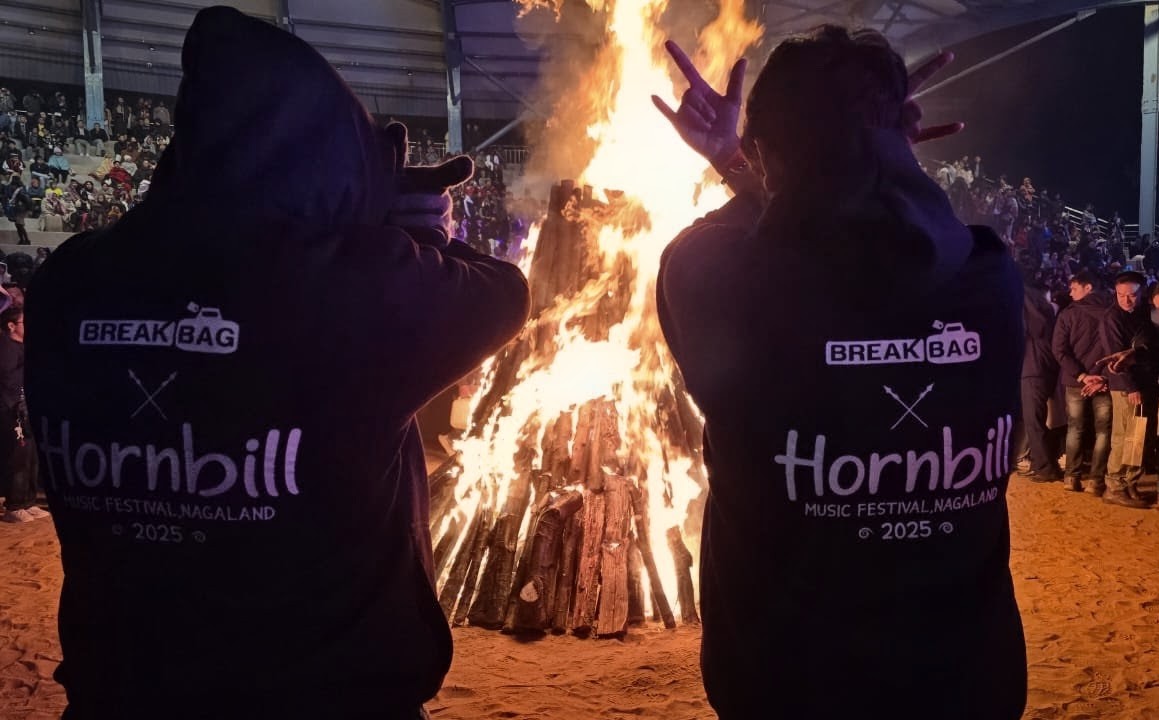
Because you will eat dinner with the family. You will sit around a bonfire — our packages include one, weather permitting — while your host explains what the carved mithun horns on the house mean. You will wake up to woodsmoke and the sound of a village, not a lobby. Your host will tell you which morung to visit first and which cousin of theirs is performing that afternoon.
A hotel gives you a room. A homestay in Hornbill Festival season gives you a family.
Practical homestay advice:
• Book absurdly early. Kigwema has finite beds. By September, the good ones are gone. This is the single biggest reason to book a package rather than wing it.
• Pack for real cold. Thermals, a proper jacket, warm socks. December in the Naga hills is not December in Kolkata.
• Carry a power bank and a torch. Both will be used.
• Bring cash from Dimapur or Kohima. ATMs in the villages are scarce and often empty during festival week.
Things to do #16–19:
16. Sleep in a Kigwema homestay within walking distance of Kisama. This is the whole game.
17. Eat a home-cooked Naga dinner with your host family.
18. Sit at the bonfire and actually talk to people instead of scrolling.
19. Walk to the festival at dawn while everyone else is stuck in traffic on the Kohima road.
If the homestay-and-community model is what draws you, you will find the same approach in our Nagaland tour packages year-round — including Magical Villages of Nagaland and Heritage of Nagaland: Kigwema to Kohima.
Beyond the Festival Ground: Khonoma Village, Dzulikie Village & Kohima Places to Visit
Here is a mistake I see every year: travellers spend four days doing nothing but Kisama, then fly home thinking they have seen Nagaland.
They have seen a festival. Nagaland is outside.
The festival runs primarily in the afternoons and evenings. Your mornings are free. Use them. Both BreakBag Packages for Hornbill festival are deliberately designed around this — village excursions by day, festival grounds by evening.
Khonoma Village — Asia's first green village
Twenty kilometres west of Kohima, Khonoma Village is one of the most remarkable places in India, and almost nobody outside Nagaland has heard of it.
This is an Angami warrior village that fought the British Empire to a standstill in the 19th century — three separate sieges, the last one in 1879, and they were never truly conquered. Walk through the stone gate and you are walking through a fort.
But its modern claim is greater. In 1998, after generations of hunting, Khonoma's community did something almost unheard of: they voted to ban hunting and logging entirely across 70 square kilometres of their own forest, creating the Khonoma Nature Conservation and Tragopan Sanctuary. They protected the endangered Blyth's Tragopan — a bird they had once hunted — by collective decision.
It earned Khonoma the title of Asia's first green village, and it is the finest example of community-led conservation I have seen anywhere in India.
Walk the terraced rice fields, which cascade down the valley in a staircase engineered centuries before anyone used the word "sustainable." Visit the stone gates. Have lunch in the village — included in both our packages.
Dzulikie Village — the honey village
Dzulikie Village is the quiet one. Tucked into forested hills on the route towards the Dzükou Valley, it is a small Angami settlement known for its wild honey, its bamboo groves, and its almost aggressive peacefulness.
There is not a great deal to do in Dzulikie, and that is precisely the point. After the sensory assault of Kisama — the drums, the crowds, the smoke — a morning in Dzulikie is a deep breath. Streams, birdsong, hills that fold into each other, and a stillness that makes you understand why the Angami never wanted to leave.
Kohima places to visit
The capital deserves at least half a day. The essential Kohima places to visit:
• Kohima War Cemetery. In 1944, the Battle of Kohima stopped the Japanese advance into India. It has been called the "Stalingrad of the East." Today, 1,400 graves rest in terraced rows on a hillside, and the epitaph at its base is one of the most quietly devastating things you will ever read. Go in the morning. Go quietly.
• Nagaland State Museum. Tribal artefacts, ceremonial gear, and the context you need to understand what you are seeing at Kisama.
• Kohima Cathedral (Mary Help of Christians). Built partly with Japanese contributions in a gesture of reconciliation. The largest cathedral in Northeast India.
• Kohima Local Bazaar. Confronting, fascinating, and utterly authentic. Not for the squeamish.
• Dzükou Valley. If you have extra days, the trek into Dzükou is one of India's great walks — a rolling green valley that looks unreal in every season.
Things to do #20–25:
20. Walk the terraced fields of Khonoma and hear the story of the 1879 siege.
21. Learn how a village voted to stop hunting — and did it.
22. Spend a slow morning in Dzulikie Village doing absolutely nothing.
23. Pay your respects at Kohima War Cemetery. Read the epitaph. Stand there a while.
24. Visit the Nagaland State Museum before Kisama, not after — the context transforms the festival.
25. Trek into Dzükou Valley if you have the extra days. You will not regret it.
For travellers extending the journey, our Nagaland Adventure: Dzuko Valley & Kohima Tour and Angami Nagaland: Kohima & Khonoma Village go deeper into exactly this terrain.
BreakBag Hornbill Festival Packages — Opening & Closing Ceremony Tours from ₹24,999
We have been curating Hornbill Packages since 2015. Here is precisely what we offer for 2026 — no fine print buried in a footnote.
Package 1 — Hornbill Festival Tour Package: Opening Ceremony 2026
30th November – 4th December 2026 | 4 Nights, 5 Days | ₹24,999 per person (down from ₹35,000)
• Day 1: Dimapur Airport → Kigwema homestay. Settle in, meet your hosts.
• Day 2: Kigwema village excursion → Hornbill Festival Opening Ceremony at Kisama.
• Day 3: Khonoma Village + Kohima War Cemetery → evening at the festival ground. (Lunch included at Khonoma.)
• Day 4: Dzulikie Village excursion → evening Hornbill Festival experience.
• Day 5: Kigwema → Dimapur Airport. (Book flights after 7 PM.)
Package 2 — Hornbill Festival Tour Package: Closing Ceremony 2026
8th – 12th December 2026 | 4 Nights, 5 Days | ₹24,999 per person (down from ₹35,000)
• Day 1: Dimapur Airport → Kigwema homestay → evening at the Hornbill Festival Ground.
• Day 2: Kigwema + Dzulikie Village excursion → evening festival performances.
• Day 3: Hornbill Festival Closing Ceremony — the emotional peak of the ten days.
• Day 4: Khonoma Village + Kohima War Cemetery. (Lunch included at Khonoma.)
• Day 5: Kigwema → Dimapur Airport. (Book flights after 7 PM.)
What is included in both
• 4 nights in a traditional homestay in Kigwema — the closest village to Kisama
• Daily breakfast (except Day 1) and daily dinner (except Day 5)
• Lunch on the Khonoma village day
• All airport, sightseeing and festival-venue transfers on a sharing basis
• Local guides for Khonoma and heritage walks
• Bonfire, weather permitting
• 24-hour customer support
What is not included — stated plainly
• GST, flights, and train tickets
• Inner Line Permit — you must arrange this yourself
• Festival entry passes — not included in the price above
• Entrance tickets, camera fees, and parking charges
• Anything not explicitly listed in the inclusions
We spell out the exclusions this clearly because we would rather lose a booking than have you arrive with a surprise. That is how we have kept a 4.8 Google rating across 700+ reviews from 25+ countries since 2015.
Why book a package rather than doing it yourself?
Because Kigwema has a finite number of beds, and by September they are gone. Because the Kohima–Kisama road in December is a car park. Because a good local guide at Khonoma turns a pretty village into a story you will retell for twenty years. Because we are recognised by the Ministry of Tourism (Govt. of India), MSME, TAAI, ATOAI, ADTOI and TAAB — and because our departures are guaranteed, meaning your trip runs regardless of group size.
Browse everything at our Hornbill destination page, or build something custom with our AI Trip Planner — it generates a full itinerary with live flight fares in about two minutes.
And once Nagaland has you, it will not let go. Explore our Meghalaya, Arunachal Pradesh, Mizoram, Ladakh, Andaman, Bhutan, Vietnam, Thailand, Bali, Singapore, Malaysia, Georgia, Oman, Kazakhstan & Almaty, Kyrgyzstan, Uzbekistan, Azerbaijan, Europe, Kenya, Taiwan and Ziro Festival packages — plus weekend getaways and Northeast offbeat trails. See the full destination list.
Kigwema has a finite number of beds. Hornbill has one December.
Every year, we watch travellers decide in October that this is finally their year — and every year, the good homestays are already gone.
Do not spend Hornbill Festival 2026 sitting in traffic on the Kohima road, watching the drums start without you.
Book your Hornbill Festival 2026 package →
Opening Ceremony: 30 Nov – 4 Dec 2026 | Closing Ceremony: 8 – 12 Dec 2026
₹24,999 per person | 4N/5D | Homestay in Kigwema, 2 km from Kisama
Call +91 76990 02674 · www.breakbag.com · Trusted by 35,000+ travellers since 2015
That morning at Kisama, after the log drum had faded and the crowd had exhaled, I turned to the Konyak elder standing beside me and asked — through a guide, clumsily — what the festival meant to him.
He thought about it for a long moment. Then he said something that the guide translated roughly as: "It means my grandchildren will know the sound."
That is what you are buying a ticket to. Not a show. A transmission — one generation handing something irreplaceable to the next, in front of anyone willing to come and witness it.
Come and witness it.
"We travel not to escape life, but for life not to escape us."
See you at Kisama.
Similar Destination
Looking for a hassle free trip?
Connect with our experts! Get the best Itineraries and Offers!